Sunday, September 11, 2016

A Speedy Way to Flip the Field

   One of the watershed moments of my coaching career occurred on a flight to the Senior Bowl when I just happened to sit behind a scout from Canada. Before I knew who he was, I found it striking that on the video players were motioning all over the field, in some cases more than one player at a time. That's when I got a lesson in Canadian football rules, or lack there of, in reference to motions.
    I was struck by the way the motion kept the defense off-balanced before the snap of the ball and was determined to incorporate it into my offensive philosophy.
    Even though American rules for football prevent more than one player in motion before the snap and also prohibit that player from moving towards the line of scrimmage before the snap, I found a way to incorporate "Speed motion" into our offense at Phillip O. Berry High School.  When I became offensive coordinator in 2012, we differentiated between speed motion and slow motion.
   The call "Mo" meant that a receiver would cross the formation as fast as possible and carry that momentum into his route which more than likely was a flat route or wheel route in some cases.  Another speed motion was tagged "orbit" which required the receiver to loop behind the tailback.  We also incorporated a motion from our jet sweep package that required the receiver to run right over the toes of the quarterback.
    As we quickly found these speed motions, allowed us to flip the field from 3x1 to 2x2 and vice versa. In two back sets, we could go from 2x1 to 3x1 or 2x2 by running "bounce" motion with the running back.  That was a little gem that we picked up from coaches like Noel Mazzone and Larry Fedora's staff at coaching clinics.
140622 WR NUMBERING06.jpg
    This became a great way to challenge the defenses responsibility and force players (not coaches) to make split second decisions.  Don't sleep on that part of the game.
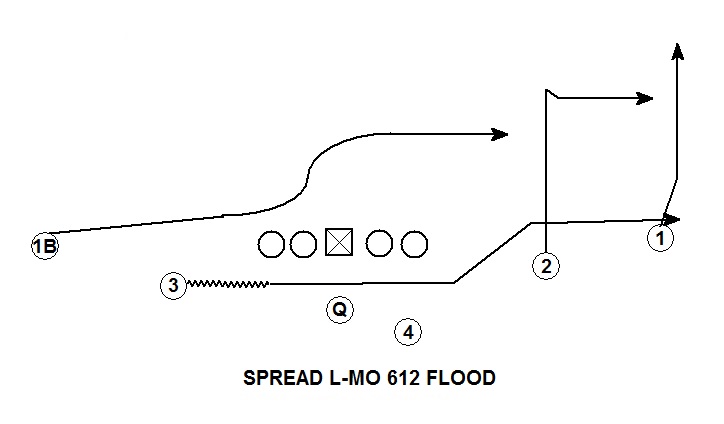
    In the above example, the left slot motions to the right side and becomes the third option in the flood play.  Because our offense was based on concepts, we developed hard rules on numbering.  A receiver motioning to the two receiver side would carry the designation of number 3 and run the corresponding route.
    The hope is the read player designated on the play would be forced to question his responsibilities because he went from dealing with a two receiver concept to a three receiver route in the blink of an eye.  Any bust on the play resulted in a positive play.  In the video below, the motion with the running back, draws the alley defender away from the post run by the number two receiver who makes the catch for a touchdown.  The speed motion allowed the quarterback to make a quicker read and deliver the ball before the receiver was covered up by the safety.  I am a firm believer that every fraction of a second counts in the game of football.


   One other benefit of speed motion is that it makes it really difficult for man-to-man defenders to disrupt a receiver's release. That was one of the things I noticed when watching Canadian football. Speed motion along with picks or rubs can be a deadly combination for you offensively.
     Before incorporating speed motion into your offense, I would recommend teaching:

1) Base passing plays conceptually and make sure that every receiver learns the corresponding routes.
2) How each motion changes the numbering of the wide receivers.
3) Quarterbacks to understand pre-snap reads and how motion will adjust those reads. After all, the offense knows what coming and the defense does not.

Below is a link to some Canadian football. Hopefully, it will spark some ideas for how to attack defenses with motion.

Canadian Football Video


Wednesday, December 16, 2015

When is empty not empty?

      On film, I noticed that Giant's Offensive Coordinator Ben McAdoo had mastered the technique of getting every available receiver into route without advertising it to defenses by lining up in a traditional empty formation.
        Against the Dolphins, his unit lined up in a routine two by two formation with 11 personnel on the field.   What made the Giants different from most NFL teams is their refusal to go "hat on a hat" in protection. Instead, they forced the defense's hand by putting everyone including the running back into the route structure.
        It reminded me of a practice back at Johnson C. Smith, when Offensive Coordinator Maurice Flowers answered the question of "Who is going to block the blitzer?" by asking likewise "Who is going to cover the back?"
         In the Monday night game, the Dolphins kept coming up with the wrong answer and it cost them dearly.
        As you see in the play below,  the Fins chose to drop the free safety down into the box, to account for the running back who delayed and attacked the alley. My guess is their intent was to roll to a three deep coverage with the other safety moving to cover the middle of the field.
         Unfortunately, he didn't roll in time to help the play side corner who just happened to be covering Odell Beckham, Jr.  The second year receiver was running a "slant and go" or "sluggo."   In case you haven't seen the highlight, Beckham torched the Dolphins and the Giants went on to win the game.
         The reason for camouflaging an empty formation this way is simple.  Most defensive coaches lick their chops when an offense lines up in empty formation.  In these cases they almost always bring the heat.  It's  a numbers advantage -- with only five blockers left in protection it only takes six rushers to get a free shot on the quarterback.
         In the Giants case, it worked out because the Dolphins blew the coverage. They chose to take a away a shorter route and gave up a home run in the process.  However, if you are going to flood the field with receivers you have to take a few things into account:

1) Can my five block their four or five?  In games where you are losing individual battles at the line of scrimmage, it could be a long day.  If it's five on four with big on big protection, you get one double team. Use it wisely.

2) Are we blocking the right five?  This is a difficult proposition against a team that specializes in masking the  blitz.  They will present seven potential blitzers at the line of scrimmage and then at the snap drop one or two into coverage. If your offensive line makes a mistake when divvying up the assignments -- it could be a problem.

3) Am I asking too much?  As I learned early in my coaching career, leaving five in to block and running all verticals is not a good idea.  In one of my first games at Phillip O. Berry, we gave up a sack while trying to hit a big play down the field and when asked why  I said, "Because they brought more than we could block."  When I took over play calling duties the next season, I made sure if we were going to empty the formation, the quarterback had options to get the ball out of his hand quickly.  It's a good idea to run quick game concepts when you are only keeping five in to block.
 

Wednesday, November 18, 2015

Seven on Seven - How to smoke out the blitz and handle that extra blitzer

      One of the most important things you have to do as a football coach is provide your team with answers to the blitz.  If you learn how to handle pressure, you will literally beg teams to blitz so you can hit them with a back breaking play.
      In a four receiver set with one running back
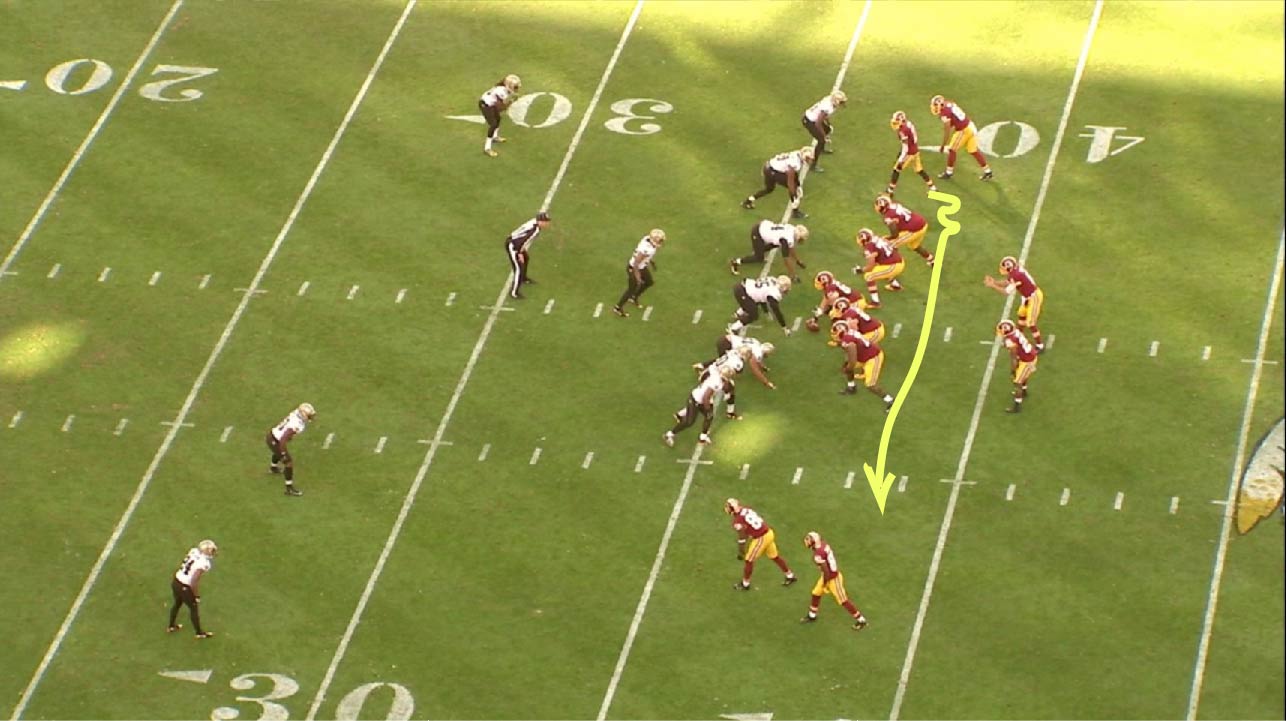
in protection you can account for six rushers at one time. However, there are times when the defense presents you with seven potential rushers and you are out numbered by one -- maybe. Not if you count the quarterback in your protection.  Here's an example of a blitz by the New Orleans Saints that hit home against Washington for a sack.
      Quarterback Kurt Cousins could not get away from the unblocked safety who came off the left edge.
       There are some things that Cousins could have done to smoke out the blitz and make sure he was protected. One of the things I teach young quarterbacks is that it's your responsibility to make sure that you are protected.  Here are some simple solutions to this play:

1) Move your receivers to figure out who is responsible for coverage.  In this case, I want to know if the defender mugged up on the line of scrimmage inside the slot is a blitzer or if he is a cover guy. Trade the slot over to the other side of the formation.  One of two things will happen.  He will go with the receiver if it's man or he will stay if he is blitzing.  If he stays, another defender will have to go with the receiver or else you will have the defense out numbered three to two.  Either way it's a win-win situation because the offensive line and running back will know which defenders to include in their protection.

2)  Set up a NOW throw. One of the
easiest solutions is to flare the running back to the plus side of the field.  We have always used the back in motion to outnumber the defense and get the ball out of the quarterbacks hands. Throwing the ball to the left against this set up would probably yield a sizeable gain because both defensive backs to the field are more than seven yards off the line of scrimmage and both will have start back pedaling at the snap. It sure beats the alternative of losing 7 to 10 yards on the sack.

3) Move the pocket.  Another solution
when you are outnumbered and out flanked is to roll away from the blitz creating some distance from the unblocked defender. It will also cut down the length of a throw to the wide side of the field.  The running back will help set a firm edge with the play side tackle. The rest of the offensive lineman work to their play side gap while not allowing any run through.  I like a deep comeback by the number one receiver in this situation with number two running a clear out and a shallow coming underneath.  The quarterback is instructed to put the ball outside where no defender will have a chance and if it doesn't look good run for whatever he can get.

4) Move the running back where you need him.  The quarterback has to put his blocker in the best possible position to succeed. If the protection remains a man to man protection with the linemen accounting for the five rushers at the line of scrimmage, the back filling the gap inside the right guard then it's much easier for him to make the block if he is on the same side.  I like using the crossing action to simulate the same flow as inside zone but will drop that window dressing to make sure that we get the pass off.  One other benefit of moving the running back is that it clears the quarterback's throwing window and helps him keep tabs on the unblocked rusher.  In this picture, the offense has accounted for six rushers including the safety (#32) posing as a mike linebacker.  The seventh rusher (#31) who ultimately makes the sack belonged to the quarterback.  So, it's up to him to think about what he is going to do when that guy comes. Sometimes, I tell our quarterback to be ready to buy some time if the unblocked man does blitz.  Most of the time, if he is successful in eluding that rusher a big play will result because our receivers are working against man-to-man coverage.


Sunday, September 27, 2015

The Eyes are the Window to Good Football

      It's been great to get back on the field coaching after a season recuperating.  One of the big challenges, I had when watching from afar last season was actually vision. I didn't see things as clearly as I had in years past.
A quick test - Can you find the fault along the offensive line?
Answer by email to coach.mcraft@gmail.com
     I mean that in both the physical sense and in the literal sense.  Over my career, one of my strengths was standing behind the offense and seeing when something was out of place. Whether it was a false step by a lineman or a missed blocking assignment.
A fellow coach once asked - "How do you see all that?"
     The answer lies in both extensive film study and
a foundation as a videographer for more than 30 years.   When a "photog" films a scene like the picture, below, he learns to look at the bigger scene and then break it down into several different shots.  One scene like this may yield a wide, medium and a number of close up opportunities.
      When it comes to football, I have an image in my mind of what the play should look like and anything that doesn't fit the template stands out like a sore thumb.
       Last season, I spent a lot of time in the press box watching games.  It was very revealing to see the game from that perch.   I would advise any offensive coordinator to head upstairs and not rely on getting second hand information from a box coach on defensive formations and schemes.
      Unfortunately, players don't have the advantage of seeing the big picture other than looking at stills or game film when they prepare for a game.  However, as a coach you can teach them see exactly what they need to see by training their eyes.  In fact, training a players eyes, no matter what position, could be the single greatest thing a coach can do to ensure his players success down the road.
      Once I got back on the field this season, one of my main goals was to train my offensive players to "get your eyes in the right place." Here are some examples of these lessons:

1) "Hands on the lineman. Eyes on the Linebacker." - When we combo block it starts with a double team on the defensive lineman.  The lineman will work that double team up to the assigned linebacker.  If both linemen focus their attention on the defense lineman they will often times be late to collect the linebacker or miss him all together and he will make the tackle.

Drill: When you work on the fundamentals of double teaming stand in the position of the linebacker and show the lineman a number one through five. The offensive lineman are supposed to call out the number. If a player is late giving the call you know that he is not getting his eyes on you as quickly as he should. This drill is also useful when working on pass blocking as well especially when working on blitz pickup.

2) "Read one player and make your initial cut" - How many times as a coach have you asked about a running back - "Why did he make that cut?"  The answer is because he is not making an initial read and/or he doesn't have a full understanding of what you are trying to accomplish on the play. Let's deal with the initial read.  I coach my running backs to take a good first step, take the hand off, make your initial read and get to the second level.  After that it's on them to be a great athlete.  As an offensive line we want to give the back the first three yards, but if he miss reads what's going on in front of him then the play is likely to fail.  It's impossible for even the best runner to read more than one or two players at a time but if they can learn to read the key block at the point of attack, it's a good start.  One inside zone, we teach our backs to press play side and  read the block on the first down lineman past the center.  This gives him a three way go -- "Bang it, Bounce it or Bend it." If the center and guard overtake the nose tackle, the choice is to hit it through the play side "A" gap.  If the nose is pushed pass the gap, the play can hit through the void created.  If the entire line slants or is pushed to the play side, our running back can bend it back behind the back side tackle.

Drill:  Break it down into small chunks. We bring the running backs and offensive line together during individual drills and work on that initial read with two lineman working their combos.  Some would say going over this read over and over again would build muscle memory, but I contend that we are building visual memory.  Over time you can see the running backs, making decisions sooner and being able to make the cuts with more certainty. One of my biggest pet peeves is a running back hesitating to make a cut or "tap dancing".  It just makes him an easier target for defensive players.

3)  Quarterback Keys -  I am a firm believer in teaching quarterbacks to adjust their reads to the structure of the defense.  For instance, if we are running the "basic" concept -- a vertical by the number one receiver and an out by the number two or running back.  If the corner is up in press coverage, we will make a high/low read on the corner.  It amazes me how many times the corner will bail leaving the flat wide open and the quarterback will not take advantage of it.  My belief is that the QB in some cases fails to get his eyes on the corner to determine his posture.  One thing we instruct QB's to do is if the corner turns away from you to run with the go route, throw the out route immediately and let's take the five yards or more that the receiver can get in open grass.  Wait too long and you lengthen the throw and put the receiver in a bad position especially if the corner comes off the deep route. With the ball in his hands early the receiver has a chance to break a tackle get a bigger play.

Drill: Once again, work small to large. Have the quarterback go over reads for each concept with only the two receivers and a coach or fellow qb's standing in as the defender.  Set up each scenario and have the coach turn to give the qb a read and see how quickly he can make the proper throw. This is a drill that can be done in the off season, even in the gym during the winter.

With all of these drills repetition is the key. Another important factor is that they mimic actual game situations.  Add these type of drills to your every day drills because you always get what you emphasize.
Wednesday, January 21, 2015

Better than the old block

    After coaching my son, Matthew, for the past three years, I had to take a season off to heal up from a series of medical issues.  It gave me a chance to just be a fan of his and I am excited about his development.     Right now, Matthew is technically more sound than I was as a senior at the University of Richmond back in 1986.
    This season, he went head to head with a few Division I prospects and other good defensive ends while making the switch to left tackle from his natural center position. This was a move I considered before taking my medical leave, and it became necessary because of a lack of tackles on the roster.
    This position change gave Matthew a chance to show some versatility to college coaches. 
     One of the reasons, I jumped at the chance to coach him in his freshman year is that as  college coach I noticed that there was a real lack of fundamentals among players arriving at our campus at Johnson C. Smith University.  One of my first meetings as running backs  coach, I wanted to find out exactly how much my guys knew so I got them on the board with a marker and asked them to draw up some simple defenses front and the result was not good. On the field, we had to teach every fundamental from stance to proper blocking technique.
     My main goal when I moved over to Berry Academy of Technology in 2010 was to take every opportunity to teach the basics of football so that if our players moved on to the next level they would be able to excel.
     Watching Matthew play, I feel certain that because of his fundamental understanding of playing offensive line and his knowledge of the game he will be able to contribute once he gets to college.
     One of the biggest things I liked on film was his ability to use his hands with proper placement.  Starting when he and two of his line mates were freshman, hand placement was one of our every day drills or EDD's.  The first thing we worked on each day was stance and then first step.  I would run the same drills I picked up from Campbell University offensive line coach Kevin Thompson who handed me a drill tape produced by Coach Chinnis Berry.
     In pass protection, he had success against highly touted players because he was precise in his hand placement.  I was glad to see our drill work carry over to the game.  When we did punch drills, I encouraged our lineman to pick as specific a target as possible. In practice are target to punch the breast plate of the shoulder pad was narrowed down to the "E" and "R" on the front of our practice jerseys.  If we were working half man on combo's it would become the "B" or "Y" depending on your post hand.
     Another thing that jumped off the film was his ability to drive defenders off the ball. He got a lot of chances to lead the way in the red zone and on a number of occasions drove his man well into the end zone.  
    On gap blocking schemes Matthew and his line mates would crush the play side shortening the corner for the puller and the running back or quarterback.   When it came time to pull on counter he did a great job of turning up in the hole and blocking his man.  In the past, we spent a lot of practice time making sure those blocks counted. I would teach them to locate the man they were responsible for on the pull and by skip pulling keep their shoulders parallel to the offensive line and eyes on the linebacker or defensive end.
   The icing on the cake, was Matthew's ability to seal the edge on outside zone.  That was a constant source of frustration in previous years for me and some of my tackles. I remember on practice reloading an outside run three or four times because my tackle just could not make that block.  When we run outside zone -- I teach lineman that we are in an overtake mentality.  Our ultimate goal is to gain a gap on defenders. If we can't overtake, then we simply take them where  they are going and allow the running back to find a crease.  This season there was no doubt that we were running outside because Matthew was not only able to overtake but also wheel around on defenders pinning them inside.
    It is so satisfying to see improvement like that from any player that you have coached but when it's your son it leaves you speechless.
    Note: Matthew and his line mate Andrew Howard both received all conference honors in the South Meck 8.  Congratulations!


Tuesday, September 23, 2014

Give a little love to ISO

        In this "Zone Blocking" World there has to be a place for a good ole isolation running play.  The weak side run that pits the fullback in a one on one match up with the linebacker. I guess the first thing you have to do is bring back the fullback.  While many of today's offenses include three and four wide receiver sets, some like Auburn Head Coach Gus Malzahn have found creative ways to get a lead blocker in the formation allowing the offense to run more traditional 21 personnel formation based runs like power and iso.
       One of these formations I call "Tulsa" -- a reference to  Malzahn's time spent as
Tulsa Right Formation
offensive coordinator with the Hurricanes.  In this set the offense lines up with three receivers out wide and a hybrid fullback/tight end or "H" lined up offset with the tailback in the base formation.  The great thing about Tulsa is it's a flexible formation that poises the question to defenses  -- is it a run or pass formation?
       As we began to incorporate this formation into our offense at Johnson C. Smith University, it became obvious that we were only scratching the surface.  In Tulsa, the offense has a chance to; overload the strong side, balance or flip the field with motion and get to just about every run in the offensive play book.  Conversely, in a four receiver spread formation, you are virtually locked into running inside or outside zone without shifting or motioning to a different formation.
      Over the years, I found that ISO was a very productive play to run out of Tulsa formation.
Tulsa Right - ISO Weak (Bend)
     We also found a way to run it without tipping our hand quite by accident.  Normally, we would move the tailback and fullback to the side of the run.  One day during inside drill, we lined up in Tulsa with the slot to the right and the tail back and H lined up to the strength as well.

      Our offensive coordinator, Maurice Flowers, called ISO to the left and I started to move the backs to the play side when Coach Flowers said  "Leave them on that side and let's see how they adjust." The first time we ran the play from this alignment, it broke loose. From my vantage point behind the play, I could see that the "Will" linebacker never saw the H until it was too late and we had him out flanked.
     Later as a play caller iso became a bigger part of my run package. I developed and taught some rules that made this play even more effective.  The first rule I gave the lead back whether a true fullback or H was to get to the outside shoulder of the linebacker on the isolation block. This is in direct contrast to what defensive coaches tell their linebackers which is to never give up their outside shoulder. My reason for teaching this was if we got outside leverage on the linebacker, we could hit this play outside the lead block and just inside the block of the offensive tackle who was taught to take a short jab step to the outside. The tackle's step forces the defensive end to widen because his first instinct is to not get reached.
     When the tail back or in some cases the quarterback hits this crease it puts him in a one on one situation with the safety. One missed tackle and he is off to the races.


Thursday, September 18, 2014

Panthers, Derek Anderson finds simple solutions to complex problems in opener

        The Carolina Panthers were expected to wilt under the Florida sun and the pressure of losing franchise quarterback Cam Newton against the Tampa Bay Buccaneers. Instead they went on the road and built a 17-0 lead before holding on for a 20-14 win. The first opening day victory for Carolina since the 2008 season.
        One of the keys to the win was the efficient way that back up quarterback Derek Anderson managed first and second downs which translated into manageable third downs especially in the first half. In the second quarter, Anderson lead a gut-busting 15 play, 69 yard drive that took the starch out of the talented Bucs defense.
        Here's an example of a play drawn up by Panthers Offensive Coordinator Mike Shula that lead to one of those big conversions:
       As you can see the Panthers are lined up in a spread formation. Tampa's defense has loaded the box with seven men at the line of scrimmage.  The Bucs have two high safeties and the corners are 7 to 8 yards off the line of scrimmage.      Basically, they are saying we will get to you before you can get the pass off.  I find it a little puzzling that while showing an all out blitz they would show this four deep look on third and only four yards to go.
        Anderson was quick to capitalize. It appeared that the veteran audibled into a play that included two quick hitting concepts on each side - one designed to beat cover two or four and one designed to beat cover-3.
       On the boundary side, the Panthers ran a concept I call "flash". In this combination,
Rookie wide receiver Kelvin Benjamin runs a square in or slant and tight end Greg Olsen runs an out route from the inside.  This is a good concept to  run versus a one high safety defense look with the corner walked off. In that case, the quarterback reads the alley defender. If the alley defender normally a safety or linebacker chases the flat route which should be his responsibility the quarterback would throw to the slant. If he drops into the slat window, then the quarterback throws to the flat.
      Because the Bucs are two hi defensive set up Anderson decided to work the the far
side of the play, where wide receivers Jason Avant and Jerricho Cotchery were running a concept I call "basic".  Basic includes a go route on the outside and an out route from the inside.  This quick game read is good against a two hi defensive set because it forces the corner to make a decision to drop with the vertical or release the vertical route and attack the flat. In this case, the corner dropped to protect against the vertical voiding the flat.  The safety who was covering the slot receiver from depth had no chance to stop the 5 yard gain that was good enough for a first down.