Saturday, April 9, 2022

Calm before the Storm

 The night before the Russian invasion on Ukraine. A former colleague sent me a link to live feed from downtown Kyiv.  It was o'dark thirty in the morning over there and all was quiet.  In the days leading up to what we now know was an all out attempt to wipe Ukraine off the map by Putin, I was struck by the beauty of this former Soviet Union republic.

Thanks to google and google maps you can quickly learn more about lands far away.  You can also take an up close look at something you would not otherwise see.  Sadly, I knew that just as easily, this place could be wiped off the face of the Earth.

I remember taking my kids to the beach when they were really small.  They couldn't wait to run up and down the beach and splash in the water.  One time, we found a sandcastle that someone left behind.  They had obviously taken time to collect the wet packing sand, put it in a mold and construct the walls before building the main castle.  

Like kids will do, they started directly towards this curiosity.  I had to hold them back from plowing right through it and destroying someone else's work.  I don't know if the person who built it was watching. It didn't matter, I was going to use this as a teachable moment  for my kids to respect others even if no one is watching.

You would think that if kids who are 4-5 years old could learn this lesson, it would be a lay up for a grown man to learn this lesson too.

It goes way beyond losing buildings for sure.  The loss of life is the main reason wars don't make sense to me.

In 1996, I went to Bosnia while working as Petersburg Bureau Chief for WWBT.  The most poignant moment of the trip came when Gene Lepley, my sidekick for the trip, and I were filming a 
Bosnian women who was mourning at the graveside of her child.  This had become a frequent ritual for her after her son was killed when the enemy lobbed a shell into the middle of the town square on a bright and sunny day.  The sad news was she wasn't alone in her grief.

In fact on that day, the square was full of young people and many of them were buried in that same cemetery.

Now, more than two decades ago right here in America, we are burying more young people than ever due to gun violence. 

Since, manning the news desk at WBTV, I have been overwhelmed by report after report of teenagers being killed in the streets of Charlotte and across the country.  At the same time, we are not hearing anyone come up with solutions to the problem.   After a 10 year-old was sent to the hospital with life-threatening injuries sustained during a random shooting at a car wash, our reporter reached out to a high ranking city official.

After a few hours, we were told that she was unavailable.  I can't quit wrap my head around exactly what unavailable would mean in this circumstance.  One teen dying is a problem.  Two is extremely disturbing but four or five is a crisis.  So that being said, I think it's time that our city and county leaders become crisis managers.

Just as they took steps to manage the covid pandemic, it's past the time to curb this latest plague:

- The city needs to initiate a curfew.  Anyone  who is under the age of  18 and is on the streets after 10 pm they need to be scooped up and escorted home.  That also means that businesses, like fast food restaurants, need to be held accountable for scheduling underage employees to work pass the curfew.  Also, high school sporting events will have to start early enough, so that students and athletes can be home when required.

- I give the school system credit for making an effort to keep guns and other weapons out of schools. Every single school needs to have a body scanners installed.  Forget testing and forget piece-mealing this solution.  Not only make the search mandatory at the start of school day but also make the penalty for violating the weapons ban permanent.  Anyone caught with a weapon on school ground should be expelled permanently.

- Parents have to do their part as well by removing an equally dangerous weapon from their child's hand - the cell phone.  As a former teacher, I know without a doubt that the majority of beef's inside the school walls start in cyberspace.  Parents need to take away cell phones and throw them in the trash can.   Nothing good comes from opening a young mind to the garbage that is pumped through Tik Tok and Instagram.  When we were on virtual schooling during the height of covid,  I know that kids were consuming hours and hours of violence, vulgar language and God knows what else during the time they should have been participating in class or studying.  Many of the students that I taught, were so dependent on their phones that they would literally breakdown when they weren't allowed to have them.  If a child ask you - "Why can't they have a cell phone?"  Tell them some thing are just not for you.

In most cases, I spend very little time telling other people what they should do.  I am more likely to look in the mirror and ask the person looking back - what can I do?  I do know that there are six seats up for re-election on Mecklenburg County's School Board in 2022, so I will be calling on close friends and associates in the political arena as I consider running.  As I get closer to retirement age, it won't take much to make myself available.  Stay tuned.

Tuesday, March 1, 2022

Like is Such a Strong Word

Many years ago, I was on a first date in Richmond, Virginia.  After a nice lunch on Cary Street, I decided to take the young lady (not named Sonya) to Byrd Park.  I know my Richmond friends and family will agree that on a nice spring day that is one of the nicest places to be in the City by the James.

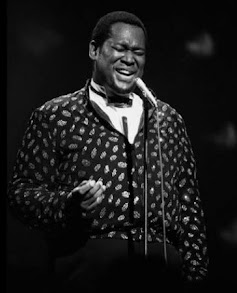
The radio station we were listening to in the car started playing a Luther Vandross song. As we listened along, my date who I only knew casually to this point turned to me and said, "I love you."

My mind raced, my sweat glands went into overdrive as I tried to come up with the right answer in milli-seconds.  I looked back and I said, "Me too."  

I know it seemed like a cop out to not go all the way, but remember this was a first date.  You don't make a leap like that on the first date.  What had I done to deserve such an outpouring of emotion?  

At that point, I wasn't ready to commit to the "L-word". Well at least not that one.  I would reserve that one for a later date and time.

Just as quickly as the moment came,  it subsided and we returned to listening to the master of love songs.  Then I got the clue that maybe my hearing wasn't quite right.  After the young lady continued to talk about the singers others songs, I realized that what she actually said earlier was, "I Love Luther."

Bare with me, because I have always wanted to put that story in writing and now I have.  My point to all of this is that there has been a cosmic shift in "L-words".  It seems to me that now, especially among millennials, "Like" has become all powerful.

I started innocently enough with social media outlets like Facebook.  When you see something nice, gently use the index finger on your right hand to press the left mouse button - "click".  

Eventually, it evolved into any overall referendum on the "SANCTITY OF MANKIND".  That's yelling I know but ask yourself if all of this isn't a little over done?

One like becomes two likes and so fourth and so on until you get a million likes.  Then people, some with no discernable skills, become famous and in some cases become quite wealthy.

Of course, there may be some people who might say that I built a 30-plus year career in broadcasting without a lot of talent either. So, I am not throwing stones.  And my concern is not for the folks who garner the lion's share of likes.

My concern is for the ones who don't.  What about the people who broadcast to the world their greatest joys and accomplishments, only to have them come back like a boomerang that misses it's mark. 

Are they judging their joy and in some cases their value to the world by the number of likes or the lack  of "likes".

On another fateful ride, this time taking my daughter, Mikaela to school, I ripped off a "Coach Craft" classic.  I encouraged her to make sure in her pursuit of a career in musical theater or acting to not do it for the applause.  I said, "Don't do it to see your name in lights. Don't do it so everyone will know your name and say how great you are."

I added that, "Even if you get all those things, it will be empty."

I maintain that like is such a strong word in this day and age but love is still stronger. More importantly it stands the test of time.

I encouraged Mikaela to instead of falling in love with the likes, fall in love with the work itself.  Take stock of the fact that you are doing something that 99.9 percent of the people will never attempt and even if they do an even smaller percentage will put in the work necessary to succeed.

Instead of counting on the world for praise and approval,  give it to yourself.  My advice: take a break from  Instagram, Twitter, Tik Tok or even Facebook .  Instead look in the mirror and give the person looking back a smile and two thumbs up.  Heck, if you got them, give four thumbs up.

More importantly, look that person in the eye and say what I didn't say on that first date - "I love you."


Sunday, February 27, 2022

Intellectual Atrophy

One of the strongest and most powerful variants of Covid-19 -- the virus that made the world stand still -- has had a profound affect on our children.  I call it "intellectual atrophy". 

Before you disregard my use of a mixed metaphor, something that I did frequently during my broadcast career for humorous effect, hear me out. 

In most cases, atrophy is used to describe the effect of inactivity on an organ or tissue like muscle.  One definition describes atrophy as, "gradually decline in effectiveness or vigor due to underuse or neglect."  

In my first year of high school football, I broke a bone in my foot in the fifth game of the season.  The doctor put it in a cast for four weeks to heal.  I held out hope that I would get the cast off and play in the last game of the year.  I really hated watching from the sideline but when I took a look at my foot after the doctor removed the cast -- it was a wrap.  

As a teacher, I had that same kind of reaction after a half semester working with my students.  A year and a half of showing up as a blank screen on zoom, many of them returned to the school building this past year suffering the side effects.

During the fall semester of 2021, I was guiding a student to an answer that was right in front of him on the computer screen.  At one point, I had to catch myself from saying in frustration, "What is wrong with you?"  Thankfully cooler heads prevailed.  More importantly I didn't have to ask the question when I already know the answer.

When muscles have experienced atrophy and you put them to work the outcome is inevitable. Any muscle that is put under stress after a prolonged period of inactivity will exhaust quickly.  I saw this coaching high school football as well.  When players are forced to do wind sprints for the first time in training camp most look like they are going to die. One thing coaches know is that the majority of players will never push themselves in the offseason  enough to be ready for the real thing.

The day I got my cast off, I could barely make it out of the doctor's office.  I certainly couldn't put my full weight on that sliver of a foot.  In an instant, I had totally given up on playing football instead I was just focused on walking across the parking lot.

A few months ago, I noticed that even my best students were hitting a wall near the end of the first quarter.  Now mind you, I wasn't teaching rocket science and I understand that my students have to reserve their energy for doing some heavy lifting like chemistry and math 3.  However, I was finding that even some of my brightest students were struggling with what I considered simple tasks.

After one student grew frustrated while trying to debug some html code she said, "Can't you just tell me what's wrong with my code?"  I made a conscious decision then, as always to not just simply tell students the answer.  

What I did was tailor my instruction to help those who were ready to run, those who are ready to walk as well as those who are barely limping along.  This was a switch for me because I am hyper competitive.  I very rarely take my foot off the gas pedal but this past year, I was forced to do just that.

During that semester, I started giving my students 10 minute breaks at the beginning and end of class.  In my longer third block, I also wrapped 10 minute breaks around lunch.  

Before covid, I asked my students to commit to learning one thing a day.  Post covid, I sometimes asked them to learn one thing over a three day period.  It wasn't the same lesson three days in a row, but the same lesson taught three different ways.

Near then end of the semester, my classes stunned me during a game we call vocabulary baseball.  Each student comes up to bat and has to give the word that matches a definition in order to get on base. I didn't expect much because I thought they weren't approaching this unit with any enthusiasm but when the game started each class knocked it out of the park.  

That game didn't alleviate all my fears for these students but it was a glimmer of hope.  

That glimmer will have to suffice because at the end of the semester, I made the tough decision to shut it down as a teacher.  Well, at least shut it down in the physical since.  Even though my personal battles with covid, sapped me of a lot of the energy necessary to handle the rigors of teaching and coaching day to day, I still plan to contribute in other ways (stay tuned).

To my former colleagues who keep fighting the good fight,  I salute you for continuing to positively affect the lives of the next generation. God Bless.


Coach Mike Craft


Sunday, December 27, 2020

Black Americans Owe Donald Trump a Great Deal of Gratitude

 Black Americans Owe Donald Trump a Great Deal of Gratitude

By  Mike Craft

    When history looks back at the one term of the 45th President, he will be celebrated by more people than you could imagine. Black folks young and old will look in reverence at the man who woke us up.

    It seems that after Barak Obama's election, we patted ourselves on the back and said "Let the brother man handle this." At the same time, the "alt's" kicked it in to high gear. That monster gain was followed by a thousand paper cuts that bled our advancements dry. During the height of the black lives matter protest across the country, I told my football players if they were looking for someone to blame -- to blame me.

    I wanted to fall on the sword because, I had laid mine down after it looked like we had finally crossed the finish line in 2008. Instead, I figured that the only thing left to do was sit back and watch my 401k grow.

    Now, in my own defense I wasn't totally idle. I volunteered at my children's schools. Then there was the time, I stepped up to fight a greedy developer whose intentions for our neighborhood were less than honorable.

    However, since then I have been M.I.A. when it comes to truly shaping my community politically.

    As they say, "Life gets in the way."

    Then along comes Trump who entered politics mouth first.  It was laughable when he first starting talking about putting our Hispanic brothers on the other side of a great wall.

    It was a little unsettling when he struck fear into the hearts of Muslim Americans.  I was heart broken to hear about the traumatic impact this was having from my new sister in law's mother, a women with a beautiful spirit. Still I did nothing.

    One by one, Trump pointed out THOSE people to his people and said they are not worthy.
Then he came for me.

    The "dog whisperer" made it loud and clear who the fine people were while at the same time began to attack members of my extended family.  If he came to the hood and trashed talked one of our women folk like he did Maxime Waters...enough said.  In doing so, he lifted the veil of racism and made it plain as day. For that, we owe him thanks.

   I used to hear my elders say the Klan put up their robes a long time ago and put on three piece suits.

    They weren't burning crosses in a field in the back woods, but torching the hopes of our people with roll backs, red lining and other hateful policies.

      Even if they weren't card carrying members, they were doing the white supremacist business by making separate not equal and justice for some.

    Still some of us, benefitted greatly from the advancements won by people like my father in law, former state senator Henry L. Marsh.

    I for one, rested on their laurels while the opposition hammered home messages of reverse discrimination and stripped away many of the programs that gave our people a leg up.

    A true confidant and mentor of mine who happens to be white asked me  - what can be done?
I said, "The next time you get a chance, promote free pre-school for all children. That would be a step in the right direction."  As Frederick Douglas said, "It's easier to build up a child than to fix a broken man."

    I don't want to hear that it's a luxury we can't afford when, at the same time, we spend millions in aid to other countries.

    Please don't confuse this for nationalism.  I believe that we ultimately will be judged by the fruit on the tree. Without a proper educational foundation, our fruit will fall far from the tree and our country's promise will wither and die.

    On election day, I think we as a people finally realized what was a stake.

    It was only fitting that the folks from cities like Philadelphia and Atlanta made their presence felt.  No doubt the phrase better late -- well actually it was early - than ever comes to mind.

    Mr. Resident for everything you have done to wake us up over the past four years, I offer this advice - "Be a man about it." You don't have to go home but you have to get out of our house.

Sunday, September 20, 2020

The Catch of a Lifetime

Today was my 56th birthday. So this afternoon, I decided to cap a quiet day with a little fishing. While heading out the door, I grabbed my prized straw hat that my son, Morgan gave me as a birthday present two years ago.  He bought it for me while we were on a family vacation in Cherokee, NC. It's a quality hat but if you know me, anything my kids give me is worth it's weight in gold.  

Often at Christmas time or on my birthday, I will immediately put on anything they give me and will often wear it with the tags still on it for weeks.  

So you can imagine the sheer terror when a gust of wind  blew it off my head and into Lake Norman.

I hadn't caught a thing and to add insult to injury there set my prized hat bobbing up and down on the water.

The symbolism was almost overwhelming and began to break me as cast after cast I came up empty handed. The frustration started to build. The sun was in my face and  made it hard to see especially when tears began to well up in my eyes. Some might say it's just a hat.

For me, it was a microcosm of parenthood. For most of their lives, I always kept my kids within reach. In the blink of an eye, they have spread out from coast to coast. Begrudgingly, I allow them to pursue their dreams wherever it may lead. To make matters worst, covid has also upended our lives. We had to shelter in different places because of various health concerns. And this year, we had to forgo our annual fourth of July family vacation - a promise I force them to keep.  Through no fault of theirs, you feel like they are drifting away.

No, I wasn't going to let Morgan's birthday gift go that easily. 

There it sat. I was amazed it stayed on top of the water. Thankfully, it landed right side up so there must have been enough air trapped underneath preventing it from sinking into this deep area near our community dock.

After several near misses with my fishing line and lure, I paused and said out loud, "Lord, don't let me loose this hat."

A few cast later, I hooked the back end of the hat and began to reel it in. The now soggy hat was heavier that any fish I had ever caught on the 8 pound test line. To keep from breaking the line, I slowly cranked the handle and ever so carefully lifted it over the rocks that lined the bank.

Sometimes, it seems like families are held together by the thinnest of  threads.  You wonder are you doing all you do to keep them close to you.  Shamefully, in brief moments of doubt, I wonder do they even need me any more?

The good thing about my pity parties is I don't throw them often and the ones I do aren't well attended.  I'll keep making the cast over and over again because as they say anything worth having is worth fighting for.


Tuesday, February 27, 2018

Just the facts...Coach

      This time of year, coaches across America are gearing up for spring football.  Most have spent the winter, combing over stats as they self scout their team and find their direction.  Many will attend conferences like the AFCA, which by the way was held in my hometown of Charlotte.  A great number go to these clinics to find the latest, greatest play.
       My philosophy has been to look for little nuggets on process - especially more efficient ways to practice and teach.
       Early in my coaching career, I was fortunate to work with Greg Richardson, former defensive coordinator at Johnson C. Smith University.  The career coach was always dispensing words of wisdom.  One of the first things he told me was to go through his drill book and find my every day drills.
       He said, "A position coach is only as good as his drill set."
       That sage advice really helped jump start my coaching career.
       Another big boost came from a YouTube video of the late Bill Walsh doing a clinic while at Stanford University.  Walsh talked about finding the balance between the number of plays that you were trying to run and making sure that you had enough practice time to run all the drills necessary to master each play in your playbook.
      That being said, the next question is -- how much is too much?  That answer can slap you in the face, especially when you consider that on every level - little league to the NFL - limitations are being placed on the amount of time that you have on the field.
        I found that on the college level the 20 hour rule has severely hindered coaches ability to really teach the game.  However, rules are meant to be followed.   So, no matter on which level you coach, adjustments have to be made on exactly how much you are trying to accomplish.
        As a journalist, one of the things that I have mastered over three decades is - asking the right question.  Every time I come into contact with a fellow coach I ask, "Coach, what do you hang your hat on?"
   
The answer varies.  Former South Carolina head coach Steve Spurrier gave me one of the best answers during a break at the South Carolina coaches convention several years ago.  The Ole Ball Coach said, "Well, it's real simple. I try to get the ball in  the hands of our best players."  Spurrier's inference was, of course, that this isn't rocket science.
         Well, if you buy into that premise then you will probably agree that it doesn't take a playbook the size of a phone book to accomplish the feat of winning football games.
         I was taught this lesson first hand going head-to-head with coaching legend Jim Oddo for three years.  You could call it a baptism under fire or you could just say we got baptized.
         The former Charlotte Catholic head coach has long been known for running the triple option.  Truth is when they run it, they run all over you.
         In our match ups, it was always such a stark difference -- our fast-paced spread offense would move down the field with the ability to take it the distance on any play while Oddo's team would play keep away for what seemed like hours when we didn't score.  I wondered why they were so good.
         My quarterbacks coach Wayne Starkes would say, "Those kids have been running those same seven plays since they were in elementary school. 
         The thought occurred to me and was confirmed by Navy coach Ken Niumatalolo that the key is indeed repetition.
          Their offense, and in turn their practices, were designed to make sure that players got enough reps to master the techniques as Walsh discussed. So, what is the right number?  Personally, I went on a quest to boil down my offense to the bare essentials.
          After years of self study, I arrived at a formula of 5 runs and 10 passing plays.  To be more specific, it's concepts not plays.  For instance,  outside zone is a blocking concept or scheme.  Using the same blocking scheme, we can hand the ball to the running back, slot back (jet sweep) or even have the quarterback run.  The largest group on the field, the offensive line, only learned one concept no matter what goes on behind them.
           In the passing game, we run schemes that attack front to back and challenge the defense from sideline to sideline.   Each scheme can be run in two-by-two, or three-by-one sets.  Motions and tags can challenge the defense as well. The result is an offense that can be installed quickly and more importantly get players playing fast because they are not bogged down with too much information.
           From that point, coaches can focus on refining techniques to make sure that these plays are run correctly. 
           Here are a few questions to ask when developing an offense:

1.  How many total plays do you run in a game? I hear the number 80 thrown around a lot.  I'm not sure if defenses coaches would be in full agreement but it's a round number.

2.  How many unique plays or concepts do you run in a game?  I remember when I first started putting together a play sheet.  It was printed on 11 by 14 inch paper.  To steal a line from my full time work - a lot of that was left on the cutting room floor.

3)  How many times do you run those plays during practice?  If you have three heavy lifting days of practice a week with 12 plays of team each day that means you have the opportunity to run 36 plays during the week.  One of the things I tried to do on my practice script was carry the same play from team apart (two offensive huddles running our first ten script in rapid succession) on to inside run or seven on seven and eventually onto the script for team.  

4)  How many times do your players (1st and 2nd team) run each play during the week?Dividing up reps can be tricky. While you want to make sure your starters get enough to be ready, you also have to consider that at some point you may have to count on one of your reserves at some point of the game.

5)   Is that enough to get good at it?  I remember Oklahoma State head coach Mike Gundy saying that he sent his coaches home at 6 o'clock because he said,  "If they stayed any longer, they would come up with some plays that we don't have time to practice."   One of my biggest fears would be to get into a game and call a critical play knowing that my team may have only run that play once or twice in team during the week.

     You can get a further explanation by watching this Players2Pros clinic at Village Christian Academy in Fayetteville in February 2018.


To hear it straight from the Master Bill Walsh himself click on these two links to here his clinic:

Bill Walsh Clinic Part 1
Bill Walsh Clinic Part 2

Please email me with questions and comments at coach.mcraft@gmail.com.


Saturday, October 7, 2017

Check Downs to First Downs

Very few people get excited about the check down pass.  These mundane little plays usually never make the cut on the highlight film.  But for those closest to the game, they are the building blocks to bigger and better things.
Check downs can extend drives.  More importantly, check downs beat the alternative of taking a sack or throwing an interception. 
There are times when this last option is the only option.  This happens when the defense is bound and determined to not get beat deep.   As seen in the picture below, on third-and-long in the second quarter, the 49ers’ defense is lined up with one high safety and the other safety is hovering in the middle of the field as a "robber". 


When the ball was snapped, the corners will drop into a cover-3 defense. The corners and safety divide the field into thirds to make the offense pay for any throw down field.  With the coverage retreating downfield, the defense is vulnerable in the flats.
Instead of risking the turnover, offensive coordinator Mike Shula calls a simple swing pass to running back Christian McCaffrey.  You can tell it's a called play, because right tackle Darryl Williams pulls as if it's a run play (picture 2).


In reality, it is a run play with a long handoff and it makes total sense.  It's also worth noting that the Panthers didn't even block the play side defensive end on the play.  Tight end Greg Olsen headed up field to block, along with wide receiver Devin Funchess.   Newton's quick throw negated the rush.


When the Panthers drafted McCaffrey in the first round of the 2017 draft, plays like this had to come to mind.   When Newton gets the ball into McCaffrey's hands, he has the ability to turn a simple check down into a special play.
In this case, McCaffrey caught the ball five yards behind the line of scrimmage (Picture 3) and after a burst of speed he cruised out of bounds with a 16 yard gain and the first down.    The play helped set up a field goal heading into halftime on the way to an opening day win.   

Sunday, February 26, 2017

Is it pe-CAN or PE-can?

     If I had to write one book about football, the title would be -- "8-Million Ways to Run Smash". This passing concept means a lot of different things to a lot of different people.  But my understanding of smash is an overall concept that involves attacking the corner with a hi-low read.          The reason for running any of the variations of this concept is to attack the vulnerable areas when faced with a two-high safety look with the corner covered down on the number one receiver.
As you see in the diagram to the right, every defensive set has vulnerable areas.  One thing you may notice is that these windows bracket different defenders.  For instance, the cornerbacks are bracketed by what we call the "flat" window and the "hole" window. The SS is bracketed by the "hole" window and the the "deep middle" window.
     The main reason we draw up plays to attack these windows is that it forces one defender to make a decision and from an offensive stand point that defender can never be right.  A little disclaimer here, when I say draw up plays; I have to admit to plagiarizing the master of the west coast offense -- Bill Walsh.  It goes without saying that west coast concepts appear in every level of the game and in every type of offense including the spread.
      The smash concept increased in popularity
at the same time as cover-two defenses.  With a hard corner taking the underneath route (hitch), the safety is left one on one with a receiver who has a two way go.  To make his job more difficult, we have our receivers run a post-corner.  We count on our number two receiver beating the safety on his corner route and making the catch behind the corner.  If the corner drops underneath the corner route, the quarterback hits the hitch and we take the gain.
      When you think about it, there are so many ways in different formations to set up this same scenario.  I will ask players to think of how many different routes attack the flat window.  Instead of a hitch, you can run - bubble or tunnel screen, flat, quick out or swing route.  In order to attack the area behind a hard corner you can run- vertical (forced outside release), curl, deep out or sail route. Here are some of those combinations and the terminology we use for each:

  • Smash = Hitch (#1) and Post-Corner (#2)
  • China = Spot (#1) and Post-Corner (#2)
  • Basic = Vertical (#1) and Speed Out (#2)
  • Flag = Out (#1) and Corner (#2)
  • Bench = Stem Corner (#1) and Flat (#2)
  • Curl/Flat = Curl (#1) and Flat (#2)


Sunday, September 11, 2016

A Speedy Way to Flip the Field

   One of the watershed moments of my coaching career occurred on a flight to the Senior Bowl when I just happened to sit behind a scout from Canada. Before I knew who he was, I found it striking that on the video players were motioning all over the field, in some cases more than one player at a time. That's when I got a lesson in Canadian football rules, or lack there of, in reference to motions.
    I was struck by the way the motion kept the defense off-balanced before the snap of the ball and was determined to incorporate it into my offensive philosophy.
    Even though American rules for football prevent more than one player in motion before the snap and also prohibit that player from moving towards the line of scrimmage before the snap, I found a way to incorporate "Speed motion" into our offense at Phillip O. Berry High School.  When I became offensive coordinator in 2012, we differentiated between speed motion and slow motion.
   The call "Mo" meant that a receiver would cross the formation as fast as possible and carry that momentum into his route which more than likely was a flat route or wheel route in some cases.  Another speed motion was tagged "orbit" which required the receiver to loop behind the tailback.  We also incorporated a motion from our jet sweep package that required the receiver to run right over the toes of the quarterback.
    As we quickly found these speed motions, allowed us to flip the field from 3x1 to 2x2 and vice versa. In two back sets, we could go from 2x1 to 3x1 or 2x2 by running "bounce" motion with the running back.  That was a little gem that we picked up from coaches like Noel Mazzone and Larry Fedora's staff at coaching clinics.
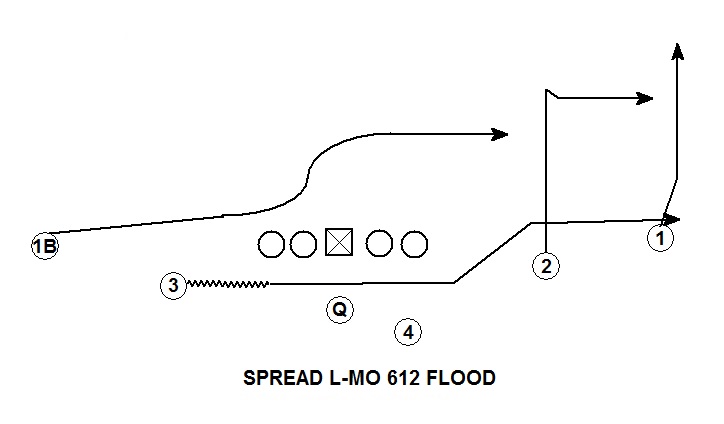
140622 WR NUMBERING06.jpg
    This became a great way to challenge the defenses responsibility and force players (not coaches) to make split second decisions.  Don't sleep on that part of the game.
    In the above example, the left slot motions to the right side and becomes the third option in the flood play.  Because our offense was based on concepts, we developed hard rules on numbering.  A receiver motioning to the two receiver side would carry the designation of number 3 and run the corresponding route.
    The hope is the read player designated on the play would be forced to question his responsibilities because he went from dealing with a two receiver concept to a three receiver route in the blink of an eye.  Any bust on the play resulted in a positive play.  In the video below, the motion with the running back, draws the alley defender away from the post run by the number two receiver who makes the catch for a touchdown.  The speed motion allowed the quarterback to make a quicker read and deliver the ball before the receiver was covered up by the safety.  I am a firm believer that every fraction of a second counts in the game of football.


   One other benefit of speed motion is that it makes it really difficult for man-to-man defenders to disrupt a receiver's release. That was one of the things I noticed when watching Canadian football. Speed motion along with picks or rubs can be a deadly combination for you offensively.
     Before incorporating speed motion into your offense, I would recommend teaching:

1) Base passing plays conceptually and make sure that every receiver learns the corresponding routes.
2) How each motion changes the numbering of the wide receivers.
3) Quarterbacks to understand pre-snap reads and how motion will adjust those reads. After all, the offense knows what coming and the defense does not.

Below is a link to some Canadian football. Hopefully, it will spark some ideas for how to attack defenses with motion.

Canadian Football Video


Wednesday, December 16, 2015

When is empty not empty?

      On film, I noticed that Giant's Offensive Coordinator Ben McAdoo had mastered the technique of getting every available receiver into route without advertising it to defenses by lining up in a traditional empty formation.
        Against the Dolphins, his unit lined up in a routine two by two formation with 11 personnel on the field.   What made the Giants different from most NFL teams is their refusal to go "hat on a hat" in protection. Instead, they forced the defense's hand by putting everyone including the running back into the route structure.
        It reminded me of a practice back at Johnson C. Smith, when Offensive Coordinator Maurice Flowers answered the question of "Who is going to block the blitzer?" by asking likewise "Who is going to cover the back?"
         In the Monday night game, the Dolphins kept coming up with the wrong answer and it cost them dearly.
        As you see in the play below,  the Fins chose to drop the free safety down into the box, to account for the running back who delayed and attacked the alley. My guess is their intent was to roll to a three deep coverage with the other safety moving to cover the middle of the field.
         Unfortunately, he didn't roll in time to help the play side corner who just happened to be covering Odell Beckham, Jr.  The second year receiver was running a "slant and go" or "sluggo."   In case you haven't seen the highlight, Beckham torched the Dolphins and the Giants went on to win the game.
         The reason for camouflaging an empty formation this way is simple.  Most defensive coaches lick their chops when an offense lines up in empty formation.  In these cases they almost always bring the heat.  It's  a numbers advantage -- with only five blockers left in protection it only takes six rushers to get a free shot on the quarterback.
         In the Giants case, it worked out because the Dolphins blew the coverage. They chose to take a away a shorter route and gave up a home run in the process.  However, if you are going to flood the field with receivers you have to take a few things into account:

1) Can my five block their four or five?  In games where you are losing individual battles at the line of scrimmage, it could be a long day.  If it's five on four with big on big protection, you get one double team. Use it wisely.

2) Are we blocking the right five?  This is a difficult proposition against a team that specializes in masking the  blitz.  They will present seven potential blitzers at the line of scrimmage and then at the snap drop one or two into coverage. If your offensive line makes a mistake when divvying up the assignments -- it could be a problem.

3) Am I asking too much?  As I learned early in my coaching career, leaving five in to block and running all verticals is not a good idea.  In one of my first games at Phillip O. Berry, we gave up a sack while trying to hit a big play down the field and when asked why  I said, "Because they brought more than we could block."  When I took over play calling duties the next season, I made sure if we were going to empty the formation, the quarterback had options to get the ball out of his hand quickly.  It's a good idea to run quick game concepts when you are only keeping five in to block.
 

Wednesday, November 18, 2015

Seven on Seven - How to smoke out the blitz and handle that extra blitzer

      One of the most important things you have to do as a football coach is provide your team with answers to the blitz.  If you learn how to handle pressure, you will literally beg teams to blitz so you can hit them with a back breaking play.
      In a four receiver set with one running back
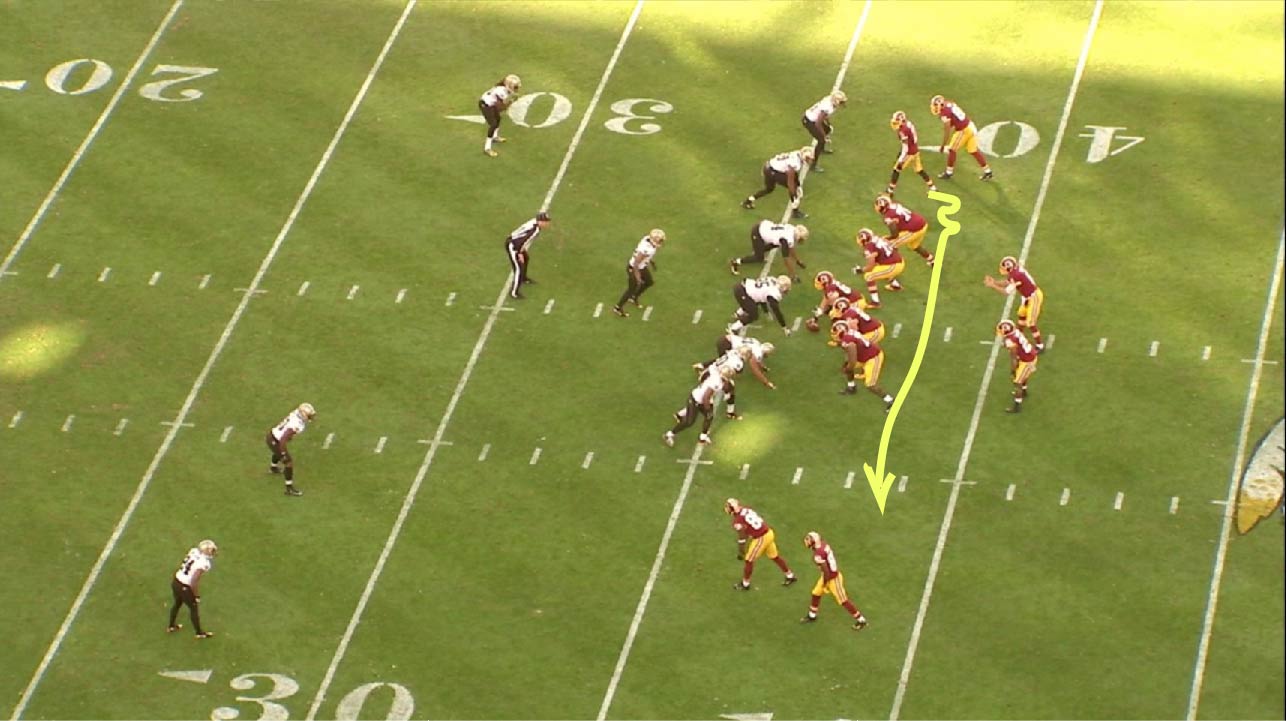
in protection you can account for six rushers at one time. However, there are times when the defense presents you with seven potential rushers and you are out numbered by one -- maybe. Not if you count the quarterback in your protection.  Here's an example of a blitz by the New Orleans Saints that hit home against Washington for a sack.
      Quarterback Kurt Cousins could not get away from the unblocked safety who came off the left edge.
       There are some things that Cousins could have done to smoke out the blitz and make sure he was protected. One of the things I teach young quarterbacks is that it's your responsibility to make sure that you are protected.  Here are some simple solutions to this play:

1) Move your receivers to figure out who is responsible for coverage.  In this case, I want to know if the defender mugged up on the line of scrimmage inside the slot is a blitzer or if he is a cover guy. Trade the slot over to the other side of the formation.  One of two things will happen.  He will go with the receiver if it's man or he will stay if he is blitzing.  If he stays, another defender will have to go with the receiver or else you will have the defense out numbered three to two.  Either way it's a win-win situation because the offensive line and running back will know which defenders to include in their protection.

2)  Set up a NOW throw. One of the
easiest solutions is to flare the running back to the plus side of the field.  We have always used the back in motion to outnumber the defense and get the ball out of the quarterbacks hands. Throwing the ball to the left against this set up would probably yield a sizeable gain because both defensive backs to the field are more than seven yards off the line of scrimmage and both will have start back pedaling at the snap. It sure beats the alternative of losing 7 to 10 yards on the sack.

3) Move the pocket.  Another solution
when you are outnumbered and out flanked is to roll away from the blitz creating some distance from the unblocked defender. It will also cut down the length of a throw to the wide side of the field.  The running back will help set a firm edge with the play side tackle. The rest of the offensive lineman work to their play side gap while not allowing any run through.  I like a deep comeback by the number one receiver in this situation with number two running a clear out and a shallow coming underneath.  The quarterback is instructed to put the ball outside where no defender will have a chance and if it doesn't look good run for whatever he can get.

4) Move the running back where you need him.  The quarterback has to put his blocker in the best possible position to succeed. If the protection remains a man to man protection with the linemen accounting for the five rushers at the line of scrimmage, the back filling the gap inside the right guard then it's much easier for him to make the block if he is on the same side.  I like using the crossing action to simulate the same flow as inside zone but will drop that window dressing to make sure that we get the pass off.  One other benefit of moving the running back is that it clears the quarterback's throwing window and helps him keep tabs on the unblocked rusher.  In this picture, the offense has accounted for six rushers including the safety (#32) posing as a mike linebacker.  The seventh rusher (#31) who ultimately makes the sack belonged to the quarterback.  So, it's up to him to think about what he is going to do when that guy comes. Sometimes, I tell our quarterback to be ready to buy some time if the unblocked man does blitz.  Most of the time, if he is successful in eluding that rusher a big play will result because our receivers are working against man-to-man coverage.


Sunday, September 27, 2015

The Eyes are the Window to Good Football

      It's been great to get back on the field coaching after a season recuperating.  One of the big challenges, I had when watching from afar last season was actually vision. I didn't see things as clearly as I had in years past.
A quick test - Can you find the fault along the offensive line?
Answer by email to coach.mcraft@gmail.com
     I mean that in both the physical sense and in the literal sense.  Over my career, one of my strengths was standing behind the offense and seeing when something was out of place. Whether it was a false step by a lineman or a missed blocking assignment.
A fellow coach once asked - "How do you see all that?"
     The answer lies in both extensive film study and
a foundation as a videographer for more than 30 years.   When a "photog" films a scene like the picture, below, he learns to look at the bigger scene and then break it down into several different shots.  One scene like this may yield a wide, medium and a number of close up opportunities.
      When it comes to football, I have an image in my mind of what the play should look like and anything that doesn't fit the template stands out like a sore thumb.
       Last season, I spent a lot of time in the press box watching games.  It was very revealing to see the game from that perch.   I would advise any offensive coordinator to head upstairs and not rely on getting second hand information from a box coach on defensive formations and schemes.
      Unfortunately, players don't have the advantage of seeing the big picture other than looking at stills or game film when they prepare for a game.  However, as a coach you can teach them see exactly what they need to see by training their eyes.  In fact, training a players eyes, no matter what position, could be the single greatest thing a coach can do to ensure his players success down the road.
      Once I got back on the field this season, one of my main goals was to train my offensive players to "get your eyes in the right place." Here are some examples of these lessons:

1) "Hands on the lineman. Eyes on the Linebacker." - When we combo block it starts with a double team on the defensive lineman.  The lineman will work that double team up to the assigned linebacker.  If both linemen focus their attention on the defense lineman they will often times be late to collect the linebacker or miss him all together and he will make the tackle.

Drill: When you work on the fundamentals of double teaming stand in the position of the linebacker and show the lineman a number one through five. The offensive lineman are supposed to call out the number. If a player is late giving the call you know that he is not getting his eyes on you as quickly as he should. This drill is also useful when working on pass blocking as well especially when working on blitz pickup.

2) "Read one player and make your initial cut" - How many times as a coach have you asked about a running back - "Why did he make that cut?"  The answer is because he is not making an initial read and/or he doesn't have a full understanding of what you are trying to accomplish on the play. Let's deal with the initial read.  I coach my running backs to take a good first step, take the hand off, make your initial read and get to the second level.  After that it's on them to be a great athlete.  As an offensive line we want to give the back the first three yards, but if he miss reads what's going on in front of him then the play is likely to fail.  It's impossible for even the best runner to read more than one or two players at a time but if they can learn to read the key block at the point of attack, it's a good start.  One inside zone, we teach our backs to press play side and  read the block on the first down lineman past the center.  This gives him a three way go -- "Bang it, Bounce it or Bend it." If the center and guard overtake the nose tackle, the choice is to hit it through the play side "A" gap.  If the nose is pushed pass the gap, the play can hit through the void created.  If the entire line slants or is pushed to the play side, our running back can bend it back behind the back side tackle.

Drill:  Break it down into small chunks. We bring the running backs and offensive line together during individual drills and work on that initial read with two lineman working their combos.  Some would say going over this read over and over again would build muscle memory, but I contend that we are building visual memory.  Over time you can see the running backs, making decisions sooner and being able to make the cuts with more certainty. One of my biggest pet peeves is a running back hesitating to make a cut or "tap dancing".  It just makes him an easier target for defensive players.

3)  Quarterback Keys -  I am a firm believer in teaching quarterbacks to adjust their reads to the structure of the defense.  For instance, if we are running the "basic" concept -- a vertical by the number one receiver and an out by the number two or running back.  If the corner is up in press coverage, we will make a high/low read on the corner.  It amazes me how many times the corner will bail leaving the flat wide open and the quarterback will not take advantage of it.  My belief is that the QB in some cases fails to get his eyes on the corner to determine his posture.  One thing we instruct QB's to do is if the corner turns away from you to run with the go route, throw the out route immediately and let's take the five yards or more that the receiver can get in open grass.  Wait too long and you lengthen the throw and put the receiver in a bad position especially if the corner comes off the deep route. With the ball in his hands early the receiver has a chance to break a tackle get a bigger play.

Drill: Once again, work small to large. Have the quarterback go over reads for each concept with only the two receivers and a coach or fellow qb's standing in as the defender.  Set up each scenario and have the coach turn to give the qb a read and see how quickly he can make the proper throw. This is a drill that can be done in the off season, even in the gym during the winter.

With all of these drills repetition is the key. Another important factor is that they mimic actual game situations.  Add these type of drills to your every day drills because you always get what you emphasize.

Wednesday, January 21, 2015

Better than the old block

    After coaching my son, Matthew, for the past three years, I had to take a season off to heal up from a series of medical issues.  It gave me a chance to just be a fan of his and I am excited about his development.     Right now, Matthew is technically more sound than I was as a senior at the University of Richmond back in 1986.
    This season, he went head to head with a few Division I prospects and other good defensive ends while making the switch to left tackle from his natural center position. This was a move I considered before taking my medical leave, and it became necessary because of a lack of tackles on the roster.
    This position change gave Matthew a chance to show some versatility to college coaches. 
     One of the reasons, I jumped at the chance to coach him in his freshman year is that as  college coach I noticed that there was a real lack of fundamentals among players arriving at our campus at Johnson C. Smith University.  One of my first meetings as running backs  coach, I wanted to find out exactly how much my guys knew so I got them on the board with a marker and asked them to draw up some simple defenses front and the result was not good. On the field, we had to teach every fundamental from stance to proper blocking technique.
     My main goal when I moved over to Berry Academy of Technology in 2010 was to take every opportunity to teach the basics of football so that if our players moved on to the next level they would be able to excel.
     Watching Matthew play, I feel certain that because of his fundamental understanding of playing offensive line and his knowledge of the game he will be able to contribute once he gets to college.
     One of the biggest things I liked on film was his ability to use his hands with proper placement.  Starting when he and two of his line mates were freshman, hand placement was one of our every day drills or EDD's.  The first thing we worked on each day was stance and then first step.  I would run the same drills I picked up from Campbell University offensive line coach Kevin Thompson who handed me a drill tape produced by Coach Chinnis Berry.
     In pass protection, he had success against highly touted players because he was precise in his hand placement.  I was glad to see our drill work carry over to the game.  When we did punch drills, I encouraged our lineman to pick as specific a target as possible. In practice are target to punch the breast plate of the shoulder pad was narrowed down to the "E" and "R" on the front of our practice jerseys.  If we were working half man on combo's it would become the "B" or "Y" depending on your post hand.
     Another thing that jumped off the film was his ability to drive defenders off the ball. He got a lot of chances to lead the way in the red zone and on a number of occasions drove his man well into the end zone.  
    On gap blocking schemes Matthew and his line mates would crush the play side shortening the corner for the puller and the running back or quarterback.   When it came time to pull on counter he did a great job of turning up in the hole and blocking his man.  In the past, we spent a lot of practice time making sure those blocks counted. I would teach them to locate the man they were responsible for on the pull and by skip pulling keep their shoulders parallel to the offensive line and eyes on the linebacker or defensive end.
   The icing on the cake, was Matthew's ability to seal the edge on outside zone.  That was a constant source of frustration in previous years for me and some of my tackles. I remember on practice reloading an outside run three or four times because my tackle just could not make that block.  When we run outside zone -- I teach lineman that we are in an overtake mentality.  Our ultimate goal is to gain a gap on defenders. If we can't overtake, then we simply take them where  they are going and allow the running back to find a crease.  This season there was no doubt that we were running outside because Matthew was not only able to overtake but also wheel around on defenders pinning them inside.
    It is so satisfying to see improvement like that from any player that you have coached but when it's your son it leaves you speechless.
    Note: Matthew and his line mate Andrew Howard both received all conference honors in the South Meck 8.  Congratulations!


Tuesday, September 23, 2014

Give a little love to ISO

        In this "Zone Blocking" World there has to be a place for a good ole isolation running play.  The weak side run that pits the fullback in a one on one match up with the linebacker. I guess the first thing you have to do is bring back the fullback.  While many of today's offenses include three and four wide receiver sets, some like Auburn Head Coach Gus Malzahn have found creative ways to get a lead blocker in the formation allowing the offense to run more traditional 21 personnel formation based runs like power and iso.
       One of these formations I call "Tulsa" -- a reference to  Malzahn's time spent as
Tulsa Right Formation
offensive coordinator with the Hurricanes.  In this set the offense lines up with three receivers out wide and a hybrid fullback/tight end or "H" lined up offset with the tailback in the base formation.  The great thing about Tulsa is it's a flexible formation that poises the question to defenses  -- is it a run or pass formation?
       As we began to incorporate this formation into our offense at Johnson C. Smith University, it became obvious that we were only scratching the surface.  In Tulsa, the offense has a chance to; overload the strong side, balance or flip the field with motion and get to just about every run in the offensive play book.  Conversely, in a four receiver spread formation, you are virtually locked into running inside or outside zone without shifting or motioning to a different formation.
      Over the years, I found that ISO was a very productive play to run out of Tulsa formation.
Tulsa Right - ISO Weak (Bend)
     We also found a way to run it without tipping our hand quite by accident.  Normally, we would move the tailback and fullback to the side of the run.  One day during inside drill, we lined up in Tulsa with the slot to the right and the tail back and H lined up to the strength as well.

      Our offensive coordinator, Maurice Flowers, called ISO to the left and I started to move the backs to the play side when Coach Flowers said  "Leave them on that side and let's see how they adjust." The first time we ran the play from this alignment, it broke loose. From my vantage point behind the play, I could see that the "Will" linebacker never saw the H until it was too late and we had him out flanked.
     Later as a play caller iso became a bigger part of my run package. I developed and taught some rules that made this play even more effective.  The first rule I gave the lead back whether a true fullback or H was to get to the outside shoulder of the linebacker on the isolation block. This is in direct contrast to what defensive coaches tell their linebackers which is to never give up their outside shoulder. My reason for teaching this was if we got outside leverage on the linebacker, we could hit this play outside the lead block and just inside the block of the offensive tackle who was taught to take a short jab step to the outside. The tackle's step forces the defensive end to widen because his first instinct is to not get reached.
     When the tail back or in some cases the quarterback hits this crease it puts him in a one on one situation with the safety. One missed tackle and he is off to the races.


Thursday, September 18, 2014

Panthers, Derek Anderson finds simple solutions to complex problems in opener

        The Carolina Panthers were expected to wilt under the Florida sun and the pressure of losing franchise quarterback Cam Newton against the Tampa Bay Buccaneers. Instead they went on the road and built a 17-0 lead before holding on for a 20-14 win. The first opening day victory for Carolina since the 2008 season.
        One of the keys to the win was the efficient way that back up quarterback Derek Anderson managed first and second downs which translated into manageable third downs especially in the first half. In the second quarter, Anderson lead a gut-busting 15 play, 69 yard drive that took the starch out of the talented Bucs defense.
        Here's an example of a play drawn up by Panthers Offensive Coordinator Mike Shula that lead to one of those big conversions:
       As you can see the Panthers are lined up in a spread formation. Tampa's defense has loaded the box with seven men at the line of scrimmage.  The Bucs have two high safeties and the corners are 7 to 8 yards off the line of scrimmage.      Basically, they are saying we will get to you before you can get the pass off.  I find it a little puzzling that while showing an all out blitz they would show this four deep look on third and only four yards to go.
        Anderson was quick to capitalize. It appeared that the veteran audibled into a play that included two quick hitting concepts on each side - one designed to beat cover two or four and one designed to beat cover-3.
       On the boundary side, the Panthers ran a concept I call "flash". In this combination,
Rookie wide receiver Kelvin Benjamin runs a square in or slant and tight end Greg Olsen runs an out route from the inside.  This is a good concept to  run versus a one high safety defense look with the corner walked off. In that case, the quarterback reads the alley defender. If the alley defender normally a safety or linebacker chases the flat route which should be his responsibility the quarterback would throw to the slant. If he drops into the slat window, then the quarterback throws to the flat.
      Because the Bucs are two hi defensive set up Anderson decided to work the the far
side of the play, where wide receivers Jason Avant and Jerricho Cotchery were running a concept I call "basic".  Basic includes a go route on the outside and an out route from the inside.  This quick game read is good against a two hi defensive set because it forces the corner to make a decision to drop with the vertical or release the vertical route and attack the flat. In this case, the corner dropped to protect against the vertical voiding the flat.  The safety who was covering the slot receiver from depth had no chance to stop the 5 yard gain that was good enough for a first down.

Sunday, September 7, 2014

Give me a choke point!

      One of my least favorites sights is eleven defenders flowing over top of any run to the outside -- on pitch or outside zone.  I always complained that when the running back gets to the so-called edge the same 7 or 8 defensive players that were in front of him at the snap are still in front of him.
      Our answer to that was to provide one or more "choke" points along the line of scrimmage. This was accomplished by having at least one fold (blocker block back) or crack on the play allowing another lineman to wrap around and rise to the second level.
       At Johnson C. Smith,  I pestered OC Maurice Flowers so much for the "crack" that he named it after me.  
       The logic of the choke point is simple - to give atleast one lineman a gimme block that will stop the flow of one defender and possibly pick up some more defenders in the wash.  Here are a couple examples of how we establish that choke point:

1) Center/Guard fold on zone run to the strength - As you see in this example, we are
running zone stretch to the right. The play side guard and tackle take their zone step and work to the outside shoulder of the defensive tackle (T)  and end (A).  Most defensive linemen will do everything they can to prevent this and this will widen the play side naturally.  The center provides the choke point by blocking back on the nose tackle (N). This accomplishes a couple things: First it allows the left guard to pull around and rise up to the second level to block the linebacker (M). It also prevents the backside defensive end front flying down the line of scrimmage in pursuit without having to work around the center's block.  Because the mike is likely to flow with the run action there is very little chance that the guard will overtake him.  That's all right because the choke will create a natural crease in front seven and once the running back sticks his foot in the ground and attacks the crease  the guard should be in perfect position to kick the linebacker to the outside. 


2) The old "Green Bay Packer Sweep" - if it was good enough for Lombardi it is certainly good enough for me.  For years I kept hearing the voice of the all-time great coach in my head extolling - "We want a seal here, and a seal here, and we will run in the alley!"  My foundation for teaching this to today's players came from Coach Joey Sulkowski who was offensive coordinator my first year at JCSU. The simple rule he taught to the offensive line was -- if you're covered pull and if you are uncovered block down.  As you can see in this example in a Pro formation that provides two choke points and allows both guards to pull. On key to running in the alley is the seal provided by the tight ends down block. I instruct tight ends to make sure that they don't must protect the gap first and then prevent the end from escaping over the top.  I the right set (two high safeties with only seven in the box) the lead block by the fullback can really help set up a big play.  in this case, he must "scrape to safety picking up a linebacker that flows over the top.  If this is a constant problem, we would add a crack on the alley defender and allow the fullback to kick the corner.